The Infamous Wedge-tailed Sparrow
By Jonah Eckels-Galbreath
October 11th, 2025 will go down in the annals of birding history; for on that day, four Missouri birders discovered a new species—the infamous Wedge-tailed Sparrow.
The birders who found this glorious bird made for a pretty haggard corps of discovery; made up as they were by Randy, who was on this third full day of birding in a row; Sam and James, who had awoken at 3 am for the dawn rendezvous; and myself, hopped up on his third cup of coffee and battling a tweaked knee. Bedecked in various shades of birder brown with a mix of footwear, ranging from utilitarian muckboots to soggy sneakers to bare feet, this crew definitely didn’t look the part of dignified ornithological heroes—especially ones you may find in the history books. But in the 21st century, you have got to take what you can get.
But the bird, oh the bird, was glorious. The color of sand and dirt with bold streaks of dark chocolate and a crown of auburn and gray and sporting just the faintest blush of orange on the cheek; this was a bird made for the glossy front pages of a birding magazine. Then of course there was its namesake tail, dark and narrow and sharp like needles, with its central two feathers creating a fine, triangular point. Surely, this bird would make the front page of the next day’s paper; the title likely reading “Unlikely Cast of Characters Discovers Little Brown Bird: Flocks of Birders Descend on Tiny Missouri Town.”
But I’m getting ahead of myself. Let’s first journey back to that mid-October day, prior to the moment of discovery.
That magical morning dawned in the muted way it does in fall with a soft grey light and the faintest of chips of migrants, descending down from the brightening sky. Somewhere off in the distance a Great Horned Owl offered its muffled greeting to the coming of another season. The juxtaposition of a relatively cool night with the coming of an unseasonably warm day—with highs ten degrees above average—created a heavy fog, cloaking the morning in an air of mystery.
From the mist emerged two cars, their headlights piercing the veil before rolling to a quick stop on a gravel lot sixty miles northwest of St. Louis. Our soon-to-be famous crew stepped boldly from their cars, coffee and binoculars in hand, ready to meet the day. Initial conversations came in hushed tones between sips of coffee. All the while we rattled off the names associated with the various tinks and rattles and chirps that emanated from bush and sedge. The day was young, but it wouldn’t be for long, so we quickly set off into the marsh.
Our choice of season and venue came as no small accident, as our search coincided with a time circled on many Missouri birders’ calendars—the second hallowed weekend of October. Revellers in this time-honored birding holiday scour marshes, damp pastures, and tilled fields in search of a grab bag of delightful little brown birds. Like a Halloween haul after a fruitful night of trick or treating, these birds come in all shades of chocolate from caramel to milk and dark to white. Making up this confectionery are birds bearing the name of LeConte, Nelson, and Baird; all are highly coveted treats, sought not for their looks, but for their highly elusive nature. With the hopes of a menagerie of mysterious sparrows, we marched off into the sodden fields of an upper Mississippi River floodplain.
The mist clung low that morning, permitting only questionable looks at the bird-shaped silhouettes darting around the yellowing sedges. We slowly worked ourselves further into the murk, picking out a bird here and a bird there. Most numerous were the long-tailed and ubiquitous, Hershey-brown Swamp Sparrows, who only days ago were somewhere north, but now seemed to be everywhere. In drier places, Song Sparrows and graham-cracker-brown Savannah Sparrows popped up, but we didn’t linger long on them, lest we miss something new. Meadowlarks sang from the wires, while flocks of blackbirds streamed by in the distance and skulking Soras sounded off from somewhere in the shin-deep grasses. Drop-dead looks at a normally hard-to-see Sedge Wren seemed a good omen for future finds, so we pushed ever onward, further into the fog.
Then without warning, a cry went up. Sam pointed to a clump of sedge, where an apparent mystery bird had hidden. Quietly we stomped over to the spot, surrounding our query in a loose square. We waited, peering deep into the reeds, until finally it popped up; flying weakly away to its next hiding place. But in those brief airborne moments, we saw a little brown bird—a bird whose name defied our immediate attempts at identification.
Our befuddled entourage of four stood there, shin deep in boot-sucking muck, stumped. The object of our intrigue calmly skulked amongst a tangle of reeds and sedges, only occasionally revealing itself. In flight, the bird had been originally called a female Bobolink, on account of its buffy appearance and chocolate-brown streaking. Seeing it now, we knew that to be incorrect. It was much too small and that tail; that tail was something different. But based on size alone, we knew that this must be a member of the LBJ family, meaning we had our work cut out for us.
LBJ’s, lovingly known as little brown jobs, often get a bad rap. Yes, they can sometimes be difficult to identify; and yes, there’s only so many ways to describe shades of brown—the famed ornithological colorist Robert Ridgway had at least sixty-nine different variations such as bone-brown, liver-brown, and mummy-brown. Also true is the fact that there are at least forty-three different sparrow species in North America north of Mexico and that doesn’t include any little brown buntings, pipits, wrens or longspurs. So we clearly had some work to do before properly identifying our little brown bird.
For our intrepid, yet befuddled crew, we could at least start to narrow down our choices. We were already quite familiar with the ever-present Swamp Sparrows, who were cloaked in too rich a chocolate-brown for our bird anyway. Hefty Song Sparrows didn’t quite work, while Savannah Sparrows piqued our interest due to our bird’s general straw-yellow appearance. Yet the accents of dark-brown on the back and orange blush on the face didn’t fit for Savannah. But the tail, sharp as it was, was the key.
So after eliminating the seemingly obvious choices, we honed in on this feature. The sharp tail most certainly held the birds’ secret, we were sure of it; as this fieldmark alone narrowed our choices down considerably. Like good Latin students, we whispered the word ammodramus, thus bringing to mind seven members of the former “grass runner” genus. Amongst this number must our sharp-tailed mystery surely belong.
This group of stealthy sparrows share a love for impenetrable spaces, interdimensional travel, and making birders look like fools. Many birders have witnessed these birds' seemingly magical ability to disappear into the grass, only to reappear a football field away. I, myself, have fallen prey to their tricks, spinning in circles to locate the bird that moments ago had surely been in front of me. The names of these tricksters are Saltmarsh, Seaside, Henslow’s, Grasshopper, Baird’s, Leconte’s and Nelson’s; all whom share a knack for simultaneously frustrating and delighting birders. But to which of this septet did our bird belong?
Immediately, we tossed out the remote possibility of Saltmarsh and Seaside Sparrow, they both prefer saltier climes, not prairie pools. More promising were the Henslow’s and Grasshopper. One check in their favor was their status as breeders in the state. Their pale, straw-brown complexion seemingly matched our bird as well. Check number two. And there was precedence for an October appearance, although both get rarer as the month goes on. Yes, they seemed quite possible, but something felt off. Consultation of digital field guides enlightened us to our error, allowing us to cross these sparrows off our list of suspects, as our bird’s sides were streaked (goodbye, Grasshopper) and its face lacked a malar stripe (adios, mustached Henslow’s). Our pool of candidates was down to three.
Momentarily, we discussed the Baird’s Sparrow; more out of hope than anything. Missouri does have six likely sightings of this northern Great Plains breeder, but to date, there’s been no photographed evidence of this bird in the state, thus it has been relegated to provisional status—meaning it has likely occurred in the state, but there is not enough evidence to conclusively add it to the all-important list. Did our crew then stumble upon the first definitive record?
No, we agreed, sadly not. Our mystery bird lacked not only the Baird’s strong mustache (malar stripe), but its chestnut-colored necklace as well. Another day then.
Thus we came to Nelson’s and Leconte’s. Nelson’s felt wrong as our bird lacked a strong gray collar, so we eliminated it without much of a conversation. Randy, the voice of reason, argued for LeConte’s, gently suggesting that we were looking at a juvenile, hence the plain features. The rest of us weren’t convinced. Our bird looked nothing like any LeConte’s we had ever seen before. Where was the pumpkin-blush, the mouse-like running? The bill? Way too large. No, this was surely not a LeConte’s Sparrow. So in the end, we poo-pooed Randy’s well-reasoned proclamation; for if all other choices had been eliminated, then this must certainly be a bird new to science.
What then was our next course of action?
Naming it of course. As the finders of the bird, we got the honor of bequeathing our mystery bird with a name. Tradition dictated that we start with its scientific name, so we placed our bird in its likely, latinized genus, Ammospiza, for of course it belonged with the other “sharp-tail” sparrows. Then we immortalized the bird’s finder—Samuel Belley—with the honorific species name of belleyi. For its English common name, the one most birders would use, we decided to commemorate the bird’s diagnostic field mark, its tail. So to no one in particular, we proudly proclaimed that our LBJ would henceforth be known as Ammospiza belleyi—the Wedge-tailed Sparrow.
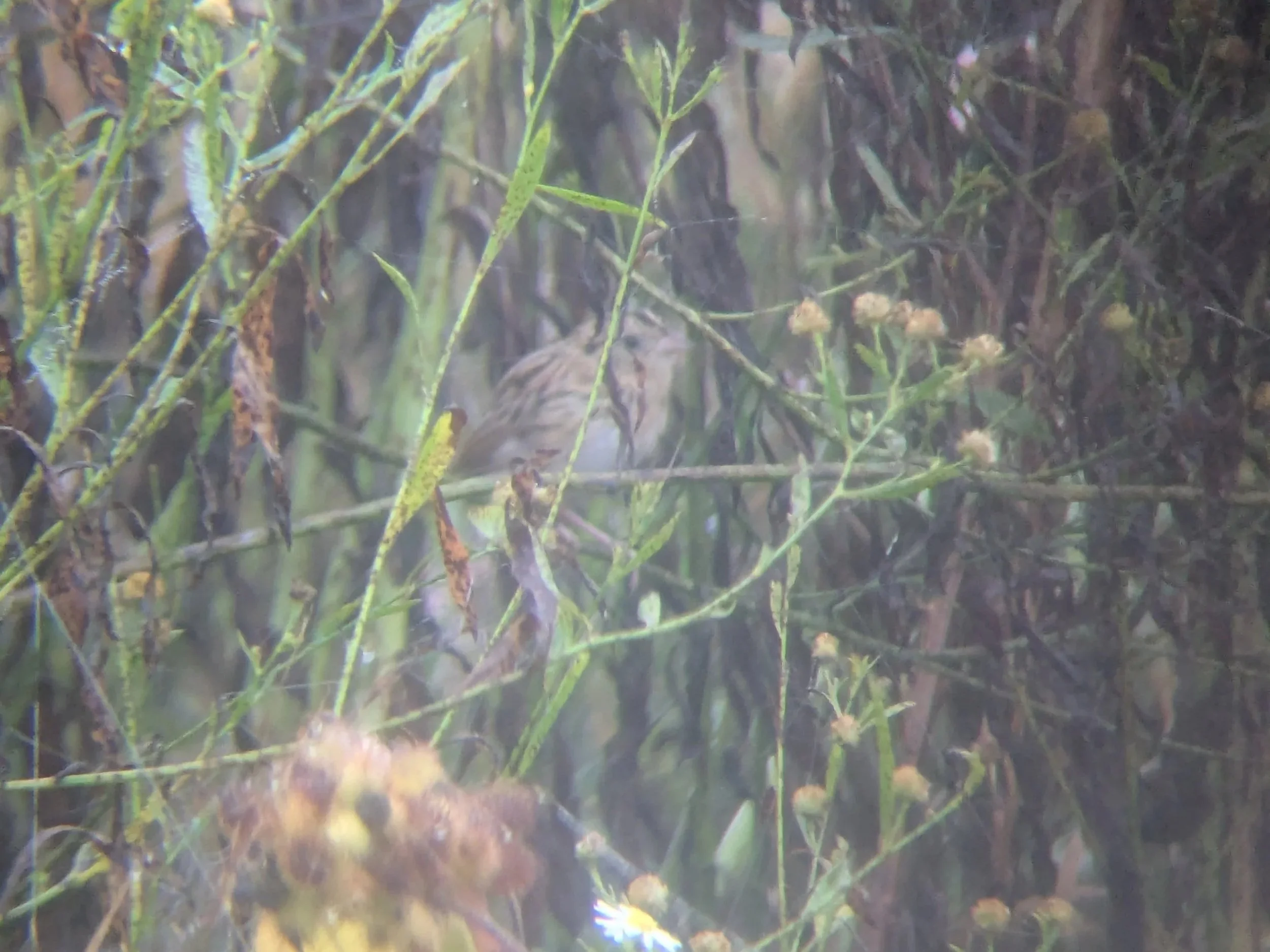
Our infamous Wedge-tailed Sparrow.
Following our find, we were buzzing, for surely, our discovery would send shockwaves throughout the birding community. We—as in me—imagined lines of birders bedecked in birder brown and muckboots; all gathering northwest of St. Louis to search for the first new bird discovered in the continental United States in over a hundred years. They would come from far and wide, hoping to glimpse our Wedge-tailed Sparrow.
Small towns along the Mississippi River, from Old Monroe to Elsberry, would surely see an economic boom due to our discovery, as there’s nothing better for business than birders who have spent the day slogging through miles of damp fields. Local spots like Cadillac Bill’s, Dickey’s Smokehouse, and Big T Deli would see an uptick in sales; as birders toasted their sparrow success with a pitcher of beer or pint of ice cream. Our October crew would then go down in history as not only the finders of the Wedge-tailed Sparrow, but as the saviors of small town America.
Of course, we first needed to verify our rare bird's identity before we alerted the press of our monumental find. Historically, many ornithologists shot, or “collected,” any bird they deemed interesting, lest they need to prove their find. We have come a long way since the 19th century, so Sam and James snapped some pictures, properly documenting our bird. Shots of the bird were sent to experts, but we were already patting ourselves on the back, the bird was practically in the bag.
After the bird slipped away, we went about our morning, seeing if we could turn up anything else unusual. A chicken-like Sora flushed from underfoot, nearly giving me a heart attack. The song of meadowlarks tinkled forth from telephone wires, while the grating calls of blackbirds echoed from the marshy grasses. We searched through every Swamp Sparrow and Sedge Wren in hopes of finding another member of the ammospiza family, but to no avail. Then at midmorning, a message arrived, the one that we thought would bolster our claims.
Alas, the message simply read: “juvenile LeConte’s Sparrow.”
Our egos immediately deflated. Quick searches on the internet brought about the finer points of LeConte’s Sparrow identification, details that we had initially overlooked. The key point being that juveniles appear less distinct than adults; the orange face, more of a dull buff; the crown washed out; and the pale breast showing fine streaking. We of course hadn’t known that, well at least not all of us. As we glumily skulked back to our cars, we could hear Randy quietly snickering behind us.
We were not the first, nor would we be the last to create a fictitious bird. John James Audubon, one of the most famous—and duplicitous—birders invented the “Bird of Washington” in hopes of selling more subscriptions to his The Birds of America. Alexander Wilson, another legendary ornithological figure, described and illustrated a bird in 1812 that he named “the Small-headed Flycatcher;” a possible member of the American warbler family that sported fieldmarks that matched no known species today and has not been found since. Sutton's Warbler, Ash-colored Sandpiper, and Little Thrush were all either hybrids, winter plumages of known birds, or amalgamations of multiple different species. Even the Sage of St. Louis, Otto Widmann, made mistakes, especially when it came to sparrows.
Widmann’s case in particular shines a light on our October sparrow conundrum. Much like us, the Sage set out on an unseasonably warm October day in 1894 with the hopes of finding something special. His venue, the prairie marshes northwest of St. Louis, lay only miles from our chosen destination. He too set out into flooded fields before dawn, glimpsing darting Swamp Sparrows, “rich yellow” Savannah Sparrows, and singing Song Sparrows. Finally, he too discovered a bird that he believed to be new; a sparrow with a black-streaked crown, a pale-yellowish appearance, and a slender, black tail.
Widmann claimed not a new bird for science, but a first for Missouri—a Baird’s Sparrow, a western bird never before documented in the state. Like us, he was eager to publicly declare his find, writing up an eight-page summary for the premier ornithological journal of his time, The Auk. Like us, he was also not a “shootist,” therefore he couldn’t provide a specimen of the bird, but unlike us he didn’t have a camera to properly document his find. So when he published his A Preliminary Catalog of the Birds of Missouri in 1907, he likely believed that his Baird’s Sparrow sighting along with a bird “taken”—read as shot—by a S.S. Wilson in western Missouri were definitive, sightings immortalized forever in the pages of journals and history books.
Unfortunately, time was not kind to Widmann’s sparrow. Reexamination of his Auk account by Dr. David Easterla showed some glaring inconsistencies between the Sage’s description and an actual Baird’s Sparrow. Additionally, two later “Baird’s” specimens proved to be juvenile LeConte’s Sparrow, an identification that fits Widmann’s bird as well. But we can give Widmann some grace, as to this day, there are no definitive records of Baird’s Sparrow in the state, only sight records and hopeful descriptions of a sparrow-find worthy of the history books.
So much like Widmann and many others before us, our autumn band of hopeful heroes did not discover a bird new to Missouri, much less science. It seems we came much too late for that. Centuries have passed since the era of Audubon, Wilson, and other ornithological pioneers, and we are even far removed from the time of Widmann, when even the marshes of St. Charles County still held the promise of new discoveries. Yet, our October sojourn will still go down in history.
That fall day our haggard crew set out into the fog in search of birds. And we found them. Flocks of blackbirds, flitting wrens, winnowing snipe, secretive Sora, and of course little brown jobs—coming in all the shades of a Halloween chocolate haul. It was also a morning reminiscent of Widmann’s journey more than a century before and of countless other marsh mornings before and since. Thus in pursuing the avian treasures northwest of St. Louis, we partook in the rich history of sparrow seekers and marsh walkers that came before and will surely come after.
Likewise, we did discover something new. Our juvenile sparrow may not have been the first ever, but it was definitely a first for us. There is no birder who knows it all—be wary of those who claim the contrary—and the best birders will tell you to take joy in learning something new. So in documenting our find, new or otherwise, we partook in a journey of discovery, through water-filled prairies and sparrow-filled binoculars to dusty-old history books and digital archives. And in the end, for a brief moment in time, our Wedge-tailed Sparrow was the first (and only) of its kind.
