A Ruff Wednesday
By: Jonah Eckels-Galbreath
Every birder has got to have one right—a hall pass list of birds that they’d drop everything to chase? If not, I highly recommend creating one, as they make the perfect excuse to get off your couch on a perfectly relaxing Wednesday night and throw caution to the wind.
My list is not long, just five or so birds that if they were to show up in the St. Louis area, I’d abandon all my current plans to chase. They’re the five I slipped into my contract (unbeknownst to my boss), just so I have a preplanned excuse for when I someday miss work. My partner is also aware of said list, one she begrudgingly accepts as part of our marital arrangement. For now, we won’t linger on all the identities of these bucket list birds, but instead will focus on just one—the bird that got me off my couch on a random Wednesday night—the Ruff.
Ruffs belong to the shorebird family, that diverse family of frustrating birds that come in all shapes and sizes, but share a passion for confusing birders, especially in fall. The Missouri list includes forty-two species of shorebirds, from common least sandpipers to the rare long-billed curlew. Ruff find themselves as rare visitors to the state, due to the fact that they belong amongst the wetlands of Eurasia or in enormous flocks in west Africa, not near an Amazon facility in suburban Missouri. There are nearly thirty records for the state—mostly in spring but with a few sightings in fall—and the last record for the St. Louis area came in April 2020, a bird that I didn’t connect with because I’d only begun my birding journey a month prior and I knew not of it’s discovery. Yet, their inclusion on my bucket list is not due to their vagrant status, nor my early miss—but for the sheer audacity of these regal birds.
Ruff are in fact the royalty of the bird world. Males come attired with flamboyant scarves that range in color from black to buff to white. Females and young birds are adorned in stately tan-brown plumages with bold orange legs that go on forever. On their breeding grounds, male ruffs duke it out in a way reminiscent of the debutante balls of yesteryear. The most fashionably garbed males show up ready to fight for female attention with outrageous displays of strength, bravado, and manliness. Others, called “satellites,” marked by their white collars, play the role of royal jester, attracting female attention to the lek, but only rarely getting the chance to mate. Finally, a small one percent of males, called “faeders,” use stealth to win a suitor. These males masquerade as females, taking advantage of the confusing reality that is avian sex by sneaking in right before consummation then darting off before anyone knows what happened. Who needs Bridgerton when you could witness all the same sexcapades on “A Court of Ruffs and Reeves” (trademark pending).
So when a Discord alert came through on a random Wednesday stating “Ruff at north end of Amazon Ponds,” I was out the door in a flash.
Rules of the road notwithstanding, I found myself running up to the settling ponds near Little Creve Coeur Marsh in record time. A crowd of twenty or so were already gathered, scopes and binoculars trained on the mudflats looking at the Ruff—or so I thought. For when I asked if they had the bird, I received a disheartening, “Maybe.”
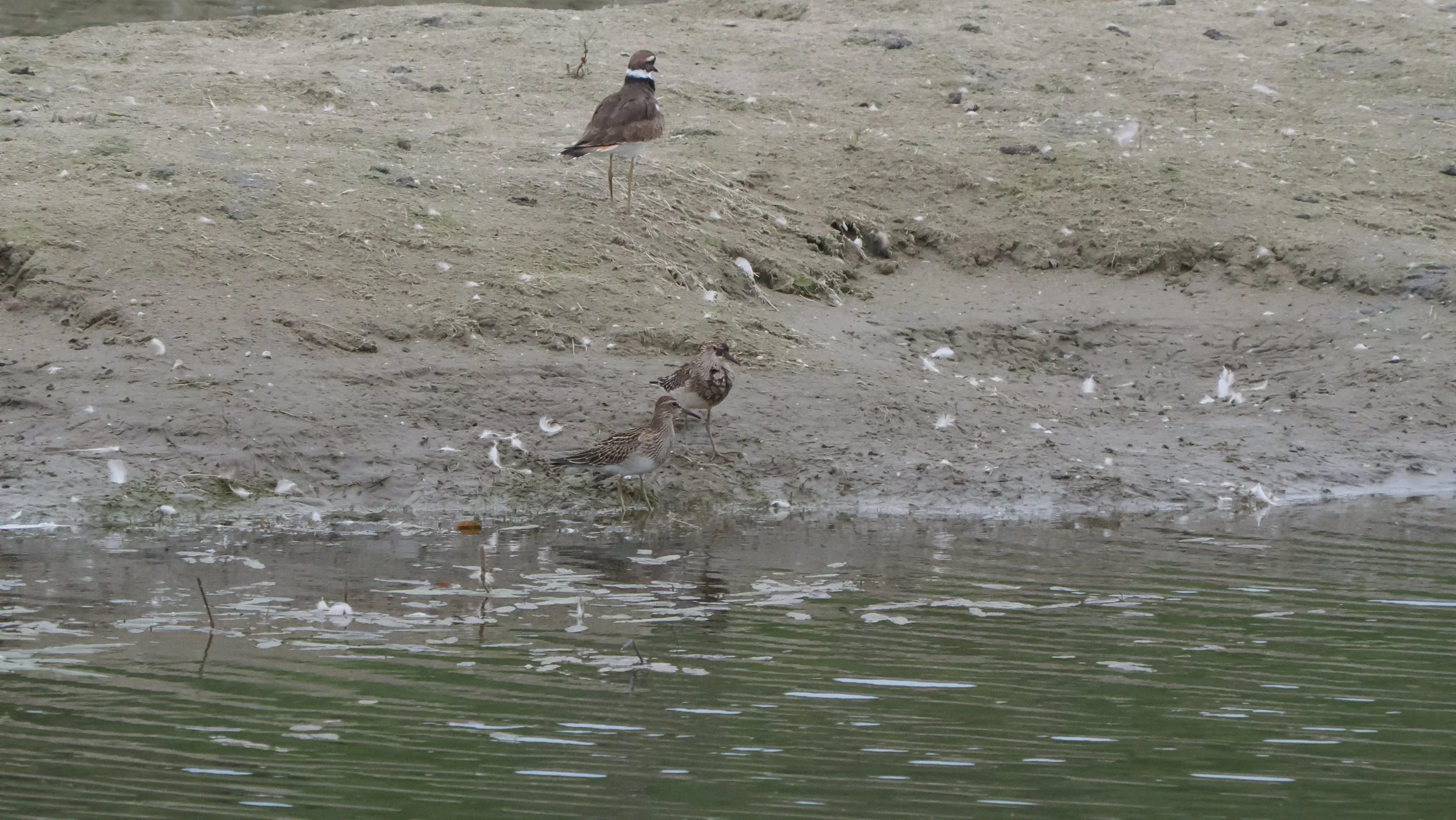
The supposed Ruff (second bird from front) with black on the chest and face behind a Pectoral Sandpiper. Photo Courtesy of Mike Grant.
Being the color of mud, it took me an embarrassing amount of time to lock eyes on the bird; but when I finally got my scope in focus, I saw quite an odd bird. It had long legs, more yellowish than orangish; its bill was dark and rather straight; and it was plump, thick and tall like a Ruff should be. However, there was the face which featured a buffy stripe above the eye and looked rather like that of a Pectoral Sandpiper—at least it did so before it turned. The face then morphed, phantom of the opera-like, into one more resembling a Ruff. Mottled dark with a patch of white at the base of the bill, a face fit for a molting fall female.
Then it turned again—and back to a dead-ringer for a Pectoral Sandpiper. The assembled crew of twenty or so birders was flummoxed. Was it an aberrant Pec? A Ruff? Some sort of hybrid? Fortunately or unfortunately, flight shots of the bird’s butt (uppertail coverts) clinched the ID as that of a Pectoral. (Pectorals have a black stripe through the rump, Ruff have a u-shaped white wedge). Without the allure of a Ruff, the crowd slowly dispersed, heading back to cold dinners and inviting couches.
I too, after a brief failed attempt to turn a Stilt Sandpiper into a Western Sandpiper, departed—ruff-less. It was not the first time I’d been duped by an odd Pectoral, nor will it likely be the last; but in spite of the miss, it was still a worthwhile endeavor. It’s not everyday I get to chase a potential bucket list bird, nor hangout with a convocation of like-minded birders—plus sitting on the couch is overrated. So no matter what, the next time a Ruff report comes in, I’ll be there in record time, ready to finally catch up with the most regal of birds.

The Phantom Ruff on the right who turned out to be a Pectoral Sandpiper. Note that both birds appear to be the same size; a Ruff would typically tower over a Pectoral Sandpiper. Photo Courtesy of Mike Grant.
References
Campagna, Leonardo. “Among Ruffs, Some ‘Fight-loving’ Fighters Don’t Like to Fight,” Cornell Lab of Ornithology, June 13, 2018, https://www.allaboutbirds.org/news/among-ruffs-some-fight-loving-fighters-dont-like-to-fight/.
Robbins, Mark. The Status and Distribution of Birds in Missouri, 2nd Edition. University of Kansas Biodiversity Institute, 2020.
Sibley, David Allen. The Sibley Field Guide to Birds of Eastern North America, 2nd Edition. Alfred A. Knopf, 2017.
