By: Jonah Eckels-Galbreath
November 6. That was the last date that Otto Widmann, a locally renowned St. Louis ornithologist, saw Chimney Swifts all the way back in the autumn of 1925. On that afternoon a hundred years past, Widmann noted eight swifts, “hunting up and down low over trees and houses in an outskirt of St. Louis like in summer.” What surprised Wimann was not the lateness of the date—although he mentioned that as well—but that freezing weather had blanketed the city in the days prior, reaching as low as 16 degrees on October 30. Where then had these birds been during these chilly nights Widmann had wondered.
Swifts, you see, are children of summer and wind. Their wings slice through the air high above the city—carefree and mesmerizing. Their happy chittering echoes the cries of children enjoying the last days of summer vacation. From Washington with their Vaux’s Swifts to the Rockies with their Black Swifts to Arizona with their White-throated Swifts to Missouri with their Chimney Swifts, no summer is complete without the aerial acrobatics of swifts.
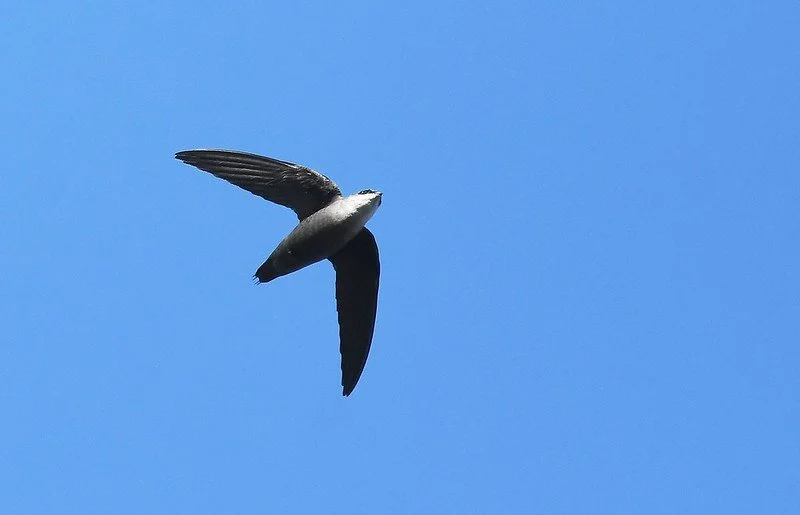
A Chimney Swift high in the summer sky. Photo Courtesy of Chrissy McClarren and Andy Reago.
Yet, one can witness true spectacles of swiftiness in fall. In fact, to truly experience a swift one must venture to a swift roost site. To find one, follow the evening swift flocks to their destination or search online for local roost sites—they often use the same sites again and again. Then put yourself in position just before sunset. First you’ll see a couple, then a few more, until eventually tornadoes of swifts descend, swirling into abandoned chimneys or hollow trees to spend a cold night amongst friends.
These mass gatherings occur throughout early fall, sometimes reaching epic proportions. Like on a late September evening in 1975, when one N. Johnson witnessed something truly spectacular—three thousand plus swifts coming to roost in downtown Kansas City, setting the official high count for the state. Likewise, in 2011 a group of Greater Ozark Audubon Society members saw 2,200 swifts drain the skies into four hollow columns in Springfield. But by October, large concentrations of swifts are rare. With their passing, swifts usher in the cool days of fall, taking the leaves and the summer wind with them.
It must be said that birders love facts and figures, so it should come as no surprise that many love to track dates as well. In the case of Widmann, his November swifts led to a proper accounting. He dug into his archives and found his last of season dates. October 21, 1917; October 10, 1918; October 19, 1919, and so on. Not satisfied with his tallies, he reached out to other fellow birders, asking them for their late dates of 1925.
Mr. Luther Ely Smith, then president of the St. Louis Bird Club, saw swifts on November 7 during a dismal and rainy football game between Washington and Missouri University. An army of green, red, and blue balloons, through which the swifts wove, fixed the date in his mind. Two days later Miss Jennie F. Chase spotted one out her window in Kimmswick. Mrs. Ridgway—wife of prominent ornithologist Robert Ridgway, but a stellar birder in her own right—recorded “summer numbers” of swifts at the high school in Lawrenceville, IL up until November 13. And Mr. T.E. Musselman reported his last swift circling the cold skies of Quincy, IL on November 16 before it too departed southward. Despite further proof of swift tardiness, Widmann was left with no answer as to how they’d survived the cold spell or why they’d lingered so late.
My latest swift record came on October 22 back in 2024 at Little Creek Nature Area. That same morning I recorded my first Fox Sparrow, Dark-eyed Junco, and other bearers of fall. Other last seen dates include October 14, 2025, October 14, 2023, and October 14, 2022; quite the coincidence of timing. So far, all my final sightings correspond with the typical departure date for swifts in Missouri, which Mark Robbins listed as “into the third week of October.”
So what of Widmann’s November swifts back in 1925? His findings, which he published in the Wilson Bulletin, proved an anomaly, a season when swifts lingered far later than normal across much of the eastern United States. In his report, he mentioned Miss Katherine H. Stuart, who observed a Chimney Swift in Alexandria, VA as late as November 19, a full month after they typically depart the area. It seemed that year that something must have delayed or kept the swifts around, although what that was remains a mystery. And since that fall, there has been only one other swift record that late in the season in Missouri—in 1986, when Timothy Barksdale found one on November 18 in Columbia.
Despite these outliers, it would seem that October skies typically carry away the last of the swifts. This fall, my last swift came on October 21; right in line with years past. This year though, I kept watching. Not because I wanted to hold on to summer—the unbearably warm temperatures were reminder enough—but because the passing of swifts represents something magical.
For when one flies over on boomerang wings and summer winds, one must look up and ponder. Pondering the feeling of freedom they must feel high on the steady winds. Or of what they see on their wanderings south—of what wonders must pass below. Or simply of swifts and their ways.
So if a swift were to linger, like they did for Widmann, I would like to be ready. Ready to bear witness to the last swifts of summer, and the passing of a season’s magic.
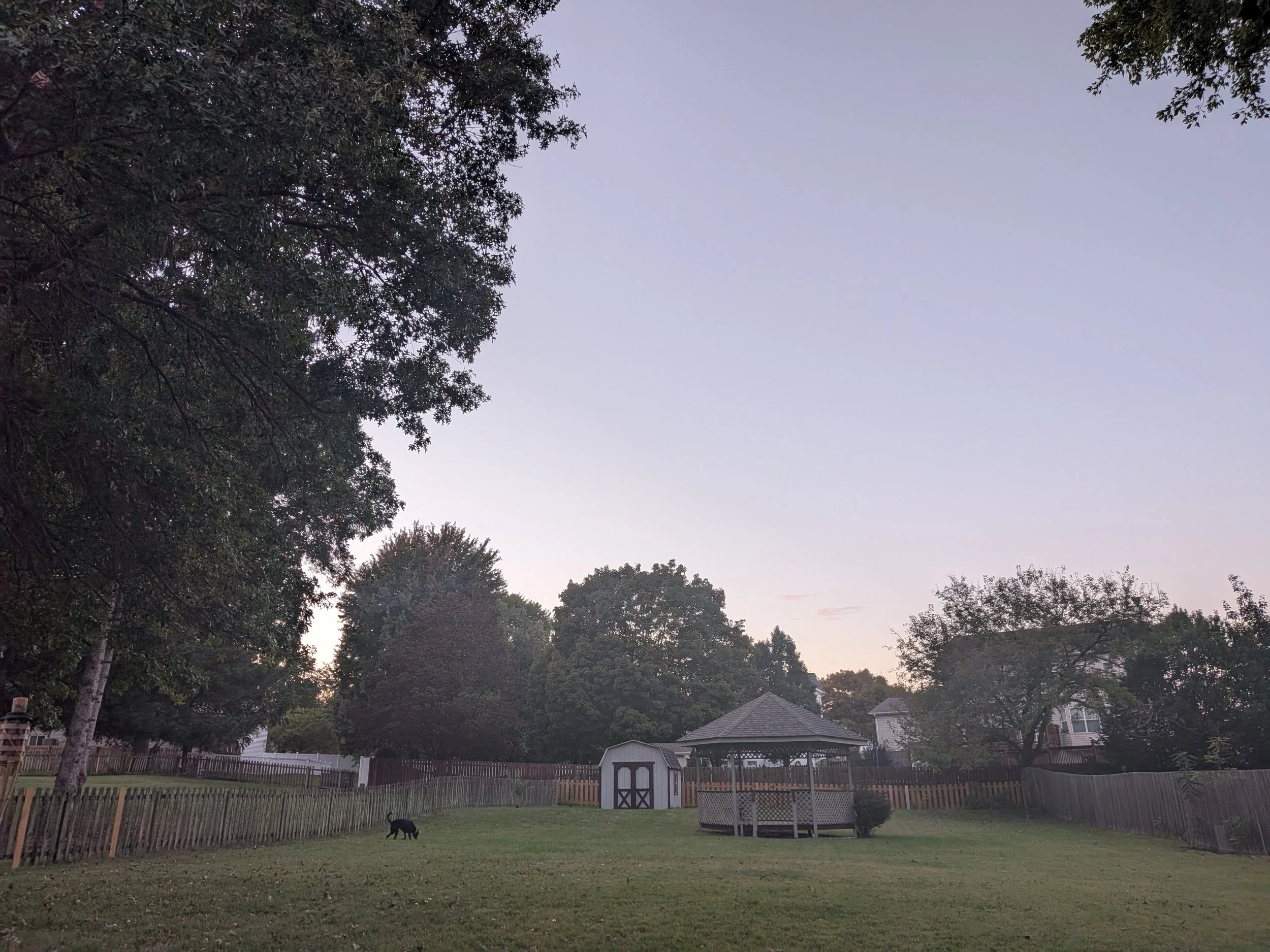
An October sky holding my last swift of summer. There’s a swift (and a dog) in this picture—I swear.
Post Note
One further reason to watch for swifts in November is for the chance to find a vagrant swift. In Missouri, the only other confirmed swift species on the state list is the White-throated Swift. This swift comes with a tragic tale—as this lone, emaciated bird was found clinging to an elevator wall at a cement manufacturing plant in Cape Girardeau on November 7, 1986, where it eventually perished. It is now housed as a specimen at Southeast Missouri State University.
However, there is a December report of a swift in 1938 that could have been a Vaux’s Swift. This small western swift closely resembles their eastern relative but unlike Chimney Swifts—who completely abandon the United States in winter for South America—Vaux’s Swifts infrequently show up north of the border in winter. In fact, there are multiple winter records in Louisiana. And these aren’t always of just lone birds, as Baton Rouge birders enjoyed flocks of up to 27 in recent years. So if you’re a Missouri birder missing your summer swifts, keep one eye upward this fall, as you never know what may turn up.
References
Reuter, Joanna. “Birds in Big Numbers: Migratory Chimney Swift Roosts.” Columbia Audubon Society, 2023. https://www.columbia-audubon.org/birds-in-big-numbers-migratory-chimney-swift-roosts/
Robbins, Mark. The Status and Distribution of Birds in Missouri, 2nd Edition. University of Kansas Biodiversity Institute, 2020.
Widmann, Otto. “Chimney Swifts in November, 1925.” The Wilson Bulletin 40, no. 3 (1928): 151-154. https://www.biodiversitylibrary.org/part/207923.
